Pilot's Guide: Manual Calculation
While modern flight decks provide instant data, every pilot should be able to calculate crosswind components manually. This guide covers the mathematical formulas and the "Clock Method" used for quick cockpit mental math.
The Trigonometric Method
The most accurate way to calculate the crosswind component is using the sine and cosine functions. This method treats the wind as a vector acting upon the runway heading.
Crosswind Formula
Where θ is the angle between runway and wind.
Headwind Formula
Decompose the total wind into the longitudinal axis.
The Clock Method (Mental Math)
In a high-workload environment, pilots use the "Clock Method" for a rapid approximation. This uses 60 minutes of a clock face to determine how much of the total wind acts as a crosswind:
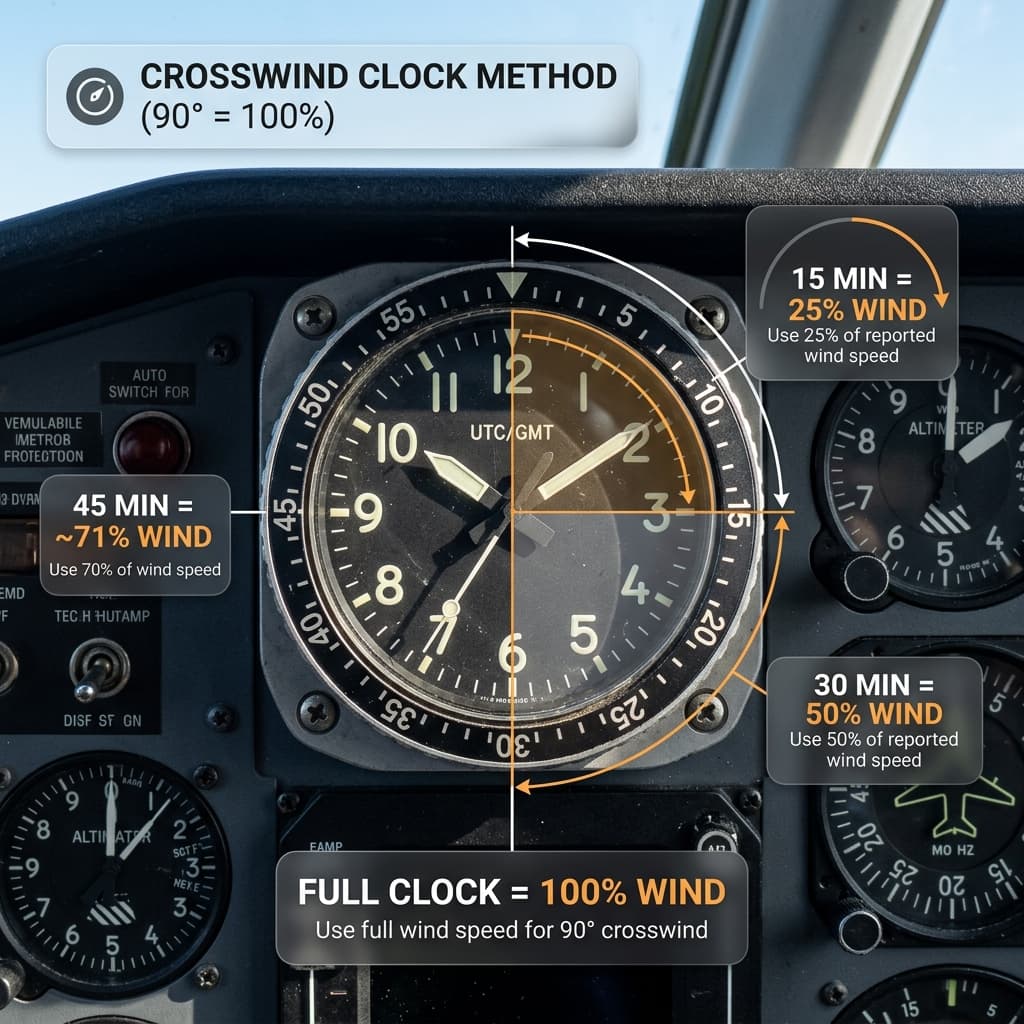
15° Angle
15m Point
30° Angle
30m Point
45° Angle
45m Point
60°+ Angle
60m Point
Why It Matters
Exceeding an aircraft's maximum demonstrated crosswind limit is a major safety risk. Decomposing these components allows for better decision-making during the approach and landing phase fixed wing flight.