POH Limits & Performance Constraints
Every certified flying machine demands immense operator respect. To safely legally pilot any complex modern airframe, a professional must thoroughly internalize the exact boundaries defined strictly within the official factory manual. This massive comprehensive technical document represents far more than an optional advisory pamphlet; it forms the definitive legal baseline for standard rigorous operation and critical safety bounds. By comprehensively mastering this explicit factory publication, aviators effectively protect themselves from hazardous edge cases, ensuring robust baseline stability while methodically avoiding mechanical catastrophe or dangerous structural fatigue. This exhaustive manual serves as the fundamental cornerstone of modern aeronautical knowledge.
Key Takeaways
- A strict baseline POH dictates explicit bounds regarding an aircraft maximum safe capabilities.
- Failing to obey a documented limitation compromises critical safety.
- Proper baseline weight and balance arithmetic fundamentally shapes airframe stability.
- Check our Aircraft Limits Database for common manufacturer benchmarks.
- An explicit factory generated checklist prevents deadly human memory failures.
- Regularly confirming fuel consumption parameters supports complete mission validity.
Table of Contents
Defining the Complete Technical Manual
Before initiating the ignition sequence, a diligent aviator conducts an exhaustive preflight walkaround. The baseline structural integrity of the machine demands physical inspection, yet the true bounds of its capability reside strictly on paper. The POH systematically formalizes decades of rigorous factory engineering into digestible chapters. This handbook breaks down every critical subsystem, explaining exactly how various hydraulic, electrical, and pneumatic networks function together to sustain safe airborne control.
Early decades of aeronautics frequently suffered from a vast absence of unified documentation. A pilot would typically transition into a new machine model blindly, relying heavily on informal word-of-mouth instruction. This dangerous guesswork naturally resulted in catastrophic failures, as individuals discovered an unknown aerodynamic limitation through fatal airborne trial and error. Modern standardization permanently eliminated this lethal ambiguity. Today, every factory issues a highly detailed manual utilizing a universally accepted standardized chapter format.
The phrase "Airplane Flight Manual" (often abbreviated as AFM) commonly describes the serialized regulatory document physically assigned to one exact tail number. The broader generalized handbook offers generalized parameters for the overall fleet model. However, any specific piece of factory avionics or aftermarket propeller modification explicitly requires a corresponding supplement stored securely with the official paperwork on board.
A Deeper Look Into Foundational Chapters
Section Two explicitly defines every hard limitation restricted by the original aeronautical architects. These unyielding redline figures dictate absolute structural constraints protecting the fuselage from failing midair. These strict guidelines prevent a pilot from accidentally damaging the primary airframe by aggressively pushing the machine far past its tested breaking point. You cannot simply ignore these factory redlines without risking structural separation or total engine failure over hostile terrain.
Engineers strictly specify the highest safe rotation rate for the internal powerplant. Exceeding the maximum published engine rpm limit often fractures critical internal crankshaft bearings, transforming a routine departure into an immediate off-airport survival scenario. A prudent operator will continually monitor engine gauges to explicitly confirm parameters never depart the specified valid green operating arcs.
Regulatory Compliance and the Approval Process
The Federal authorities vigorously governs the strict certification process demanding massive volumes of proof before allowing a new aircraft design into commercial or private service. Factory test pilots frequently subject prototype airframes to grueling stress profiles deliberately engineered to push wings until they snap. This explicit destruction data ultimately defines the official baseline strength boundaries documented permanently within the aeronautical handbook.
Regulatory oversight fundamentally guarantees that any licensed operator commands an airplane possessing predictable handling characteristics. An experienced flight instructor heavily depends entirely upon this published predictability to safely teach novice students handling basics without facing unpredictable inverted aerodynamic behavior. When a baseline model achieves full regulatory certification, it receives an official type approval verifying its inherent compliance with all robust stability requirements.
Manufacturer Responsibilities
The original manufacturer acts as the primary custodian of this technical knowledge base. When ongoing fleet data reveals a previously unknown mechanical weakness, the factory must proactively issue an authorized revision. An owner must completely update their specific assigned manuals to explicitly reflect new emergency protocols or revised airspeed restrictions. Flying securely demands possessing the absolute most current data available.
Historic POHs lacked the universal formatting standard seen exclusively today, often leading to critical data scattered haphazardly throughout confusing appendices. The modern standardization dramatically improves cockpit workflow, allowing a stressed crew member to rapidly locate a critical system schematic or specific limitation exactly when a high-workload crisis erupts. This structured formatting saves countless lives.
Managing Crucial Weight Distributions
Proper payload loading strongly represents the most critical arithmetic task a pilot routinely completes. The machine must confidently hoist its own empty mass, massive volumes of combustible liquid, and the fragile human occupants nested within the main fuselage. Calculating the total combined gross weight guarantees the wings possess sufficient lift capacity to physically hoist the metal structure cleanly away from the ground.
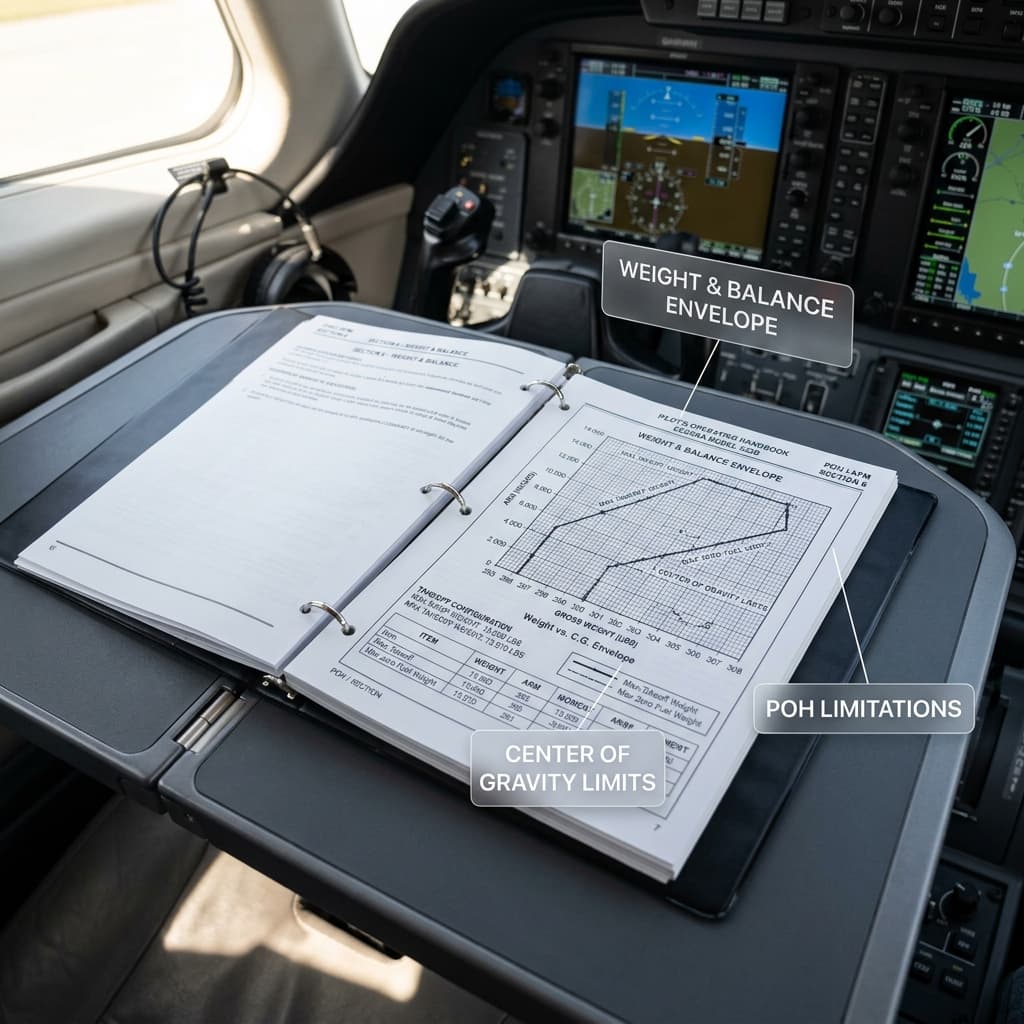
However, merely respecting the maximum weight ceiling ignores a far more insidious aerodynamic danger. You must distribute this mass correctly. The physical location of passengers and cargo directly controls the overall balance point. The balance location strictly dictates the baseline longitudinal stability pitch characteristics of the flying airframe.
Decomposing the Safety Bounds
A specific authorized performance envelope defines the exact permissible regions for loading. If you carelessly place massive heavy cargo squarely in the aft baggage compartment, the balance location aggressively migrates backward. An excessively aft point of balance severely degrades longitudinal trim authority. The nose naturally pitches upward uncontrollably, forcing the wings rapidly toward their absolute critical angle of attack.
Eventually, the aerodynamic airflow separates completely, inducing a violent unrecoverable aerodynamic stall. With the mass heavily biased toward the tail section, the typical recovery procedure of lowering the nose becomes physically impossible due to massive elevator authority loss. Pilots explicitly execute a formal weight and balance mathematical worksheet utilizing a standardized lever-arm chart prior to every single takeoff to explicitly prevent this exact scenario.
Furthermore, consuming fuel throughout the journey inherently alters the distribution profile. A conscious crew must strictly evaluate their projected arrival state. A heavy load that falls securely within the accepted valid bounds prior to engine start may dangerously creep entirely outside the mandated limits after four solid hours of continuous airborne operations.
Decoding Advanced Aircraft Capabilities
Extracting optimal baseline performance necessitates heavily dissecting the comprehensive graphs explicitly provided in section five. These dense charts predict exactly how rapidly the airframe will accelerate, climb, and cruise. True airspeed predictably varies significantly depending squarely upon the exact air density, ambient temperature, and chosen cruising altitude parameters.
An airframe generates primary drag inherently by moving aggressively through the viscous atmosphere. Extracting maximum longitudinal range demands carefully setting the propeller and throttle controls to a specific optimal economy profile explicitly tested by the factory engineers. Flying faster forcefully requires exponentially more internal horsepower to overcome this parasitic atmospheric resistance, drastically increasing overall hourly fuel consumption.
Navigating Crucial Speeds
The handbook explicitly details a massive variety of key target V-speeds. A pilot thoroughly memorizes these exact knots indicated values. The best angle of climb velocity allows the airframe to cleanly out-climb a tall obstacle immediately off the departure end, sacrificing some forward vector energy for vertical height gained per horizontal distance traveled.
Conversely, respecting the maximum published structural cruising speed prevents massive turbulent air gusts from violently warping the primary load-bearing wing spars. Attempting to recklessly fly significantly faster than this documented redline during turbulent weather deliberately courts instantaneous midair structural integration failure. The technical manual strictly establishes an absolute never-exceed speed, commonly marked prominently on the airspeed indicator dial via a solid red radial line. Every pilot rigidly respects this explicit boundary.
Furthermore, heavily pulling aggressive g-force loads within steep spiral turns acts to vastly increase the airplane's effective weight. This forcefully requires an aviator to actively monitor their bank angle. Exceeding valid structural limit loads definitively warp a flawless airframe into un-flyable scrap metal.
Immediate Actions During Airborne Crises
A catastrophic mechanical failure instantly triggers a massive cascade of intense adrenaline. Professional aeronautical training strictly dictates relying entirely on a published factory checklist rather than flawed human memory when diagnosing a massive system failure. The third chapter of any standard operating manual details the exact sequence of required corrective inputs for handling everything from an alternator belt failure to an intense uncontained cabin fire.
If the primary engine permanently suffocates mid-air, a pilot must seamlessly pitch explicitly for the published best-range aerodynamic glide speed. Attaining this exact specific numeric value supports the dead machine will physically travel the furthest possible distance forward while slowly descending toward a forced landing site. Traveling either wildly faster or dangerously slower will strictly heavily reduce the overall reachable descent footprint, converting a safe off-field touchdown into a certain total terrain impact.
Executing Established Procedures
Thoroughly memorizing critical memory items forms the foundation of robust survival. While a dense printed book holds exact details, a pilot physically cannot waste critical split seconds blindly flipping through dense paper pages while thick smoke fills the pressurized flight deck. The explicit emergency procedures demand rapid immediate rote execution of fundamental steps—such as securing the primary fuel selector valve or deploying the emergency backup landing gear crank—before pulling out the QRH binder to diligently mop up the remaining detailed secondary schematic items.
Every certified POH deeply acts to distill vast decades of bloody regulatory aeronautical history into safe systematic rules. A highly competent flight instructor consistently drills a new pilot exhaustively regarding these foundational metrics until their execution becomes seamless muscle memory. Operating a complex fast-moving machine requires massive diligence, exact profound precision, and total strict unyielding adherence to the absolute explicit boundaries established comprehensively by the original certified baseline manufacturer test team. You systematically verify your capabilities every single journey specifically to support you ultimately land totally safely. The explicit limitations section protects your fundamental survival securely during every single takeoff.
Frequently Asked Questions
What exactly is an aircraft POH?
The POH is a standardized document detailing specific operational boundaries, performance graphs, and emergency checklists for a specific airplane tail number.
How does the FAA regulate a POH?
Aviation regulatory authorities require manufacturers to test airframes and formalize the results into an approved flight manual before issuing a certificate.
Why is the CG envelope critical?
The center of gravity strongly dictates the stall characteristics and control authority of an aircraft. Exceeding the CG limits can cause an unrecoverable flight state.