Cessna 172 (C172) Maximum Demonstrated Crosswind Limits
Aircraft Details
This specific trainer represents the most successful training airframe ever built. Mastering the techniques required to operate this platform during challenging weather systems remains critical to sustained operational survival.
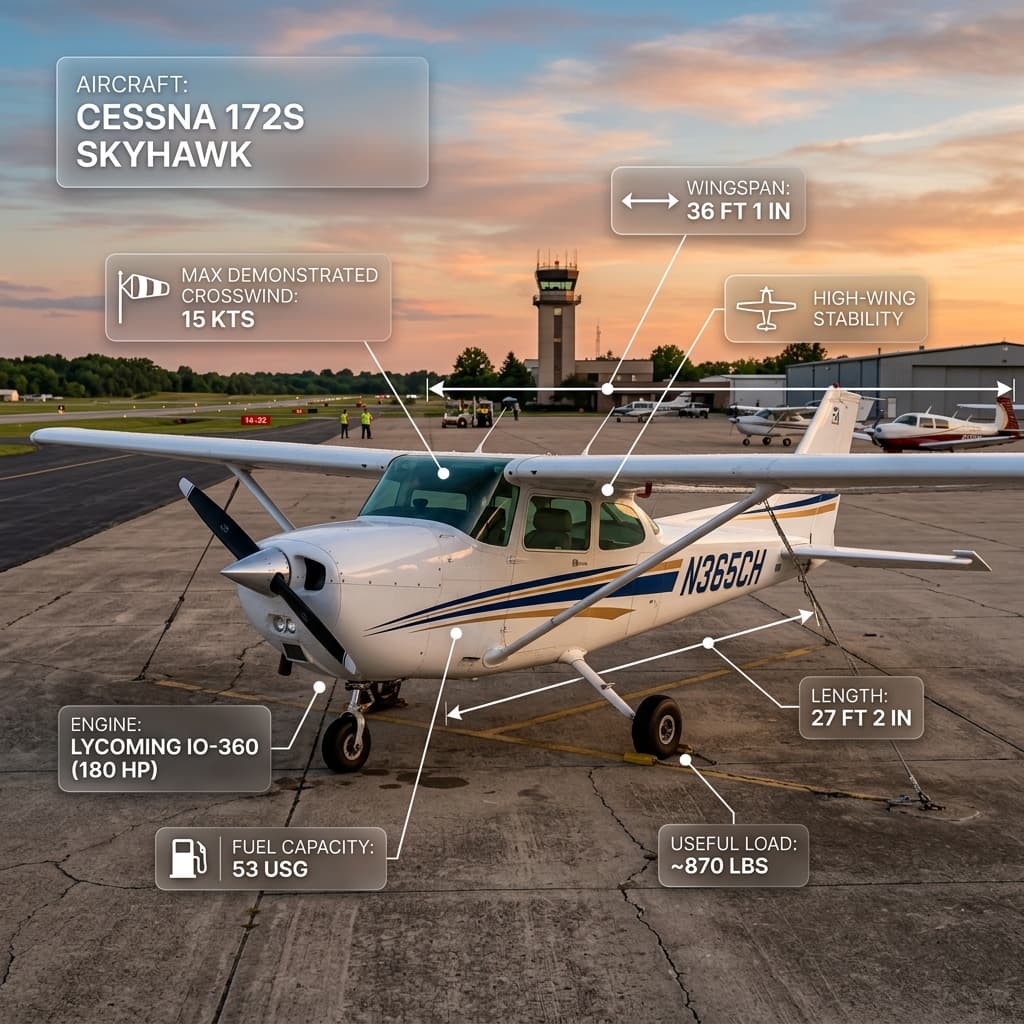
The Certification Benchmark
As an aviator advances beyond baseline maneuvers, they inevitably encounter aggressive atmospheric forces. Operating a complex machine near the ground requires absolute precision, particularly when handling a lateral disruption.
Aeronautical Definition
The Maximum Demonstrated Crosswind Component is the velocity at which a factory test pilot maintained safe, repeatable control authority during certification flights.
It is critical to recognize that this published metric is not a hard legal limitation for Part 91 operations. Instead, it serves as a reliable benchmark confirming the aircraft has sufficient control surface deflection to counteract a perpendicular force.
Key Certification Facts:
- Standard LogicCertification requires demonstrating handling in 90-degree winds equal to 20% of stalling speed.
- C172 BaselineFor the Skyhawk, this mathematical baseline settled precisely at the 15-knot mark.
The prominent high-wing configuration inherently exposes a massive amount of lateral surface area. During a turbulent ground roll, the high wing acts like a horizontal sail, requiring preemptive spatial reasoning to prevent the aircraft from being displaced off the paved surface.
Physics of the Landing Profile
Maintaining lateral stability while initiating a complex crosswind landing profile separates amateur operators from professionals. As the tires approach the asphalt, the longitudinal axis must point directly down the painted centerline.
The Secret to Flawless Alignment:
Establishing a crossed-controlled slip involves separating your physical flight controls into two distinct roles (as detailed in our landing techniques guide):
- 1
Primary Yoke (Ailerons): Perfectly counteract lateral drift by lowering the upwind wing downward into the incoming moving ocean of air.
- 2
Foot Pedals (Rudder): Apply opposite pressure to force the engine cowling to swing parallel with the runway environment.
A proficient CFI demands that students maintain this configuration until the upwind main tire makes solid contact. Prematurely relaxing leg pressure prior to touchdown causes "weathervaning"—the natural tendency of the large vertical tail to pivot the chassis into the flow.
Wind Speed and Geometric Analysis
A tower controller broadcasts the current wind speed and magnetic direction. Safe execution requires decomposing this raw vector into an actionable crosswind component. You can use our step-by-step calculation guide to master this process.
| Angle Offset | Crosswind Factor |
|---|---|
| 30 Degrees | 50% of Total Velocity |
| 45 Degrees | 70% of Total Velocity |
| 60+ Degrees | 90-100% of Total Velocity |
There exists zero professional shame in intelligently aborting a messy, un-stabilized approach. Electing to push the throttle forward and abandon a deteriorating arrival demonstrates exceptional aeronautical maturity.
Mitigating Gust Variability
Atmospheric environments rarely match theoretical textbook conditions. When velocities surge violently upward, we experience a dangerous physical gust.
Handling Chaotic Weather:
- Reduce Flap Deflection: A smaller flap profile decreases the lateral surface area exposed to sideways pushing forces.
- Increase Approach Speed: Add half of the reported gust factor to your final approach velocity as a kinetic buffer.
- Proactive Adjustments: Use constant, tiny adjustments rather than large, sluggish, reactionary inputs.
This aircraft operates exceptionally predictably when correctly configured, efficiently absorbing significant turbulence while remaining responsive to immediate aileron corrections.
The Final Approach
Finally, extracting premium utility out of a certified 172 relies upon discipline. When your computations confirm that the component exceeds your established comfort envelope, you intelligently abort the mission.
Recognize that executing a sound crosswind landing demands blending academic mathematics with instinctive visceral sensory feedback. You feel the shifting pressure building dynamically across the rudder pedals. Following these rigid baseline values supports that the aircraft remains intact.
Related Questions
What is the demonstrated maximum crosswind for a standard C172?
The handbook explicitly lists 15 knots as the certified threshold achieved during factory testing scenarios.
Are crosswinds identical to total wind speeds?
No, the component specifically refers strictly solely to the perpendicular fraction pushing sideways directly against the aircraft profile, calculated purely via angular difference geometry.
Important Disclaimer: The calculated results and limits provided by this tool are for reference and educational purposes only. They are not a substitute for official flight manuals, pilot operating handbooks (POH), or professional flight instruction. Always compute your own values and consult official documentation to ensure safe flight operations. The creator assumes no liability for the accuracy or use of this tool.